
During a special session on June 1-2, 2026, the Florida Legislature passed a proposed constitutional amendment — CS/HJR 1F — to be placed on the November 2026 general election ballot. Constitutional amendments require 60% voter approval to pass.
What's being proposed
- Raise the homestead property tax exemption from $50,000 to $150,000 for non-school levies, beginning January 1, 2027.
- Raise it again to $250,000, beginning January 1, 2028, with inflation indexing beginning in 2029.
- Constitutionally mandate the Legislature to create a schedule for full elimination of homestead property taxes, with no deadline specified and no replacement revenue identified.
Additional Restrictions
In addition, the amendment restricts the use of property taxes to the following:
- Provide for public safety, including law enforcement, fire service, and emergency medical service;
- Provide funding for education and public schools;
- Finance or refinance infrastructure, including expenditures on road and bridge construction and maintenance and stormwater control;
- Finance or refinance natural resource projects, including flood control measures;
- Issue local bonds for uses consistent with this paragraph and to make debt service payments for existing obligations;
- Meet obligations for retirement benefits of local government employees; or
- Fund the operations and administration of county officers and commissioners established under Article VIII and municipalities, and the expenditures approved by such county officers or county or municipal governing bodies, except those expenditures prohibited by general law.
Property tax examples
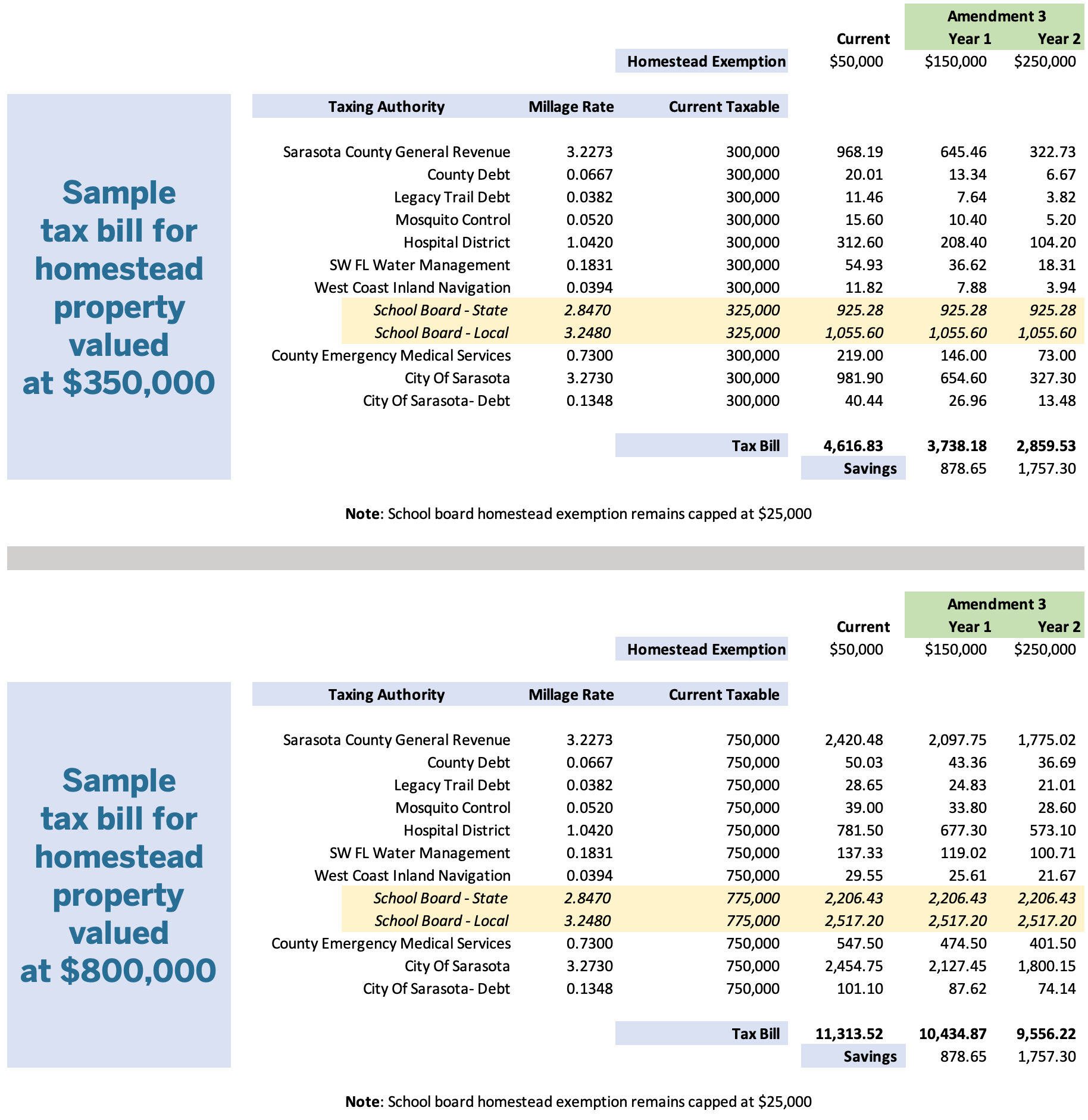
Note: There are no changes for people who rent or owners of commercial properties.
Impact on City General Fund
The increased homestead exemption of $250,000 would result in a loss of $655 per household to the city (based upon a mileage rate of $3.273):
That reduction would be spread across these functions:
| Per household | |
| Culture and Recreation | $73 |
| General Government | $149 |
| Transportation | $54 |
| Human Services | $7 |
| Physical Environment | $19 |
| Public Safety | $348 |
| Other Departments | $5 |
| Total | $655 |
Beyond just reduced overall funding, these restrictions put many services in jeopardy…
City Funding | Exposure under proposed amendment | Why |
Public-art acquisitions, artist commissions, art programming, and cultural placemaking | High | Art and cultural programming are not listed as a permitted funding category. |
Grants or subsidies to arts, cultural, civic, tourism, or nonprofit organizations | High | Money transferred to an outside organization is less readily characterized as the City’s own operations. |
Economic-development subsidies, private redevelopment incentives, business grants, and marketing | High | These do not plainly fall within public safety, infrastructure, natural resources, debt, pensions, or direct municipal operations. |
Festivals, events, sponsorships, promotions, and tourism-oriented programming | High | These are discretionary expenditures, not named constitutional purposes. |
Recreation programming, youth sports, camps, pool programming, athletic events, and community-center programs | Moderate to high | Recreation is not listed; direct City operation is more defensible than grants to private providers. |
Park amenities, playgrounds, recreational facilities, and landscaping | Moderate | Routine parks-department management could be “operations”; stormwater, flood control, conservation, or infrastructure within a park have stronger independent grounds. |
Historic-preservation grants, façade incentives, private-property rehabilitation assistance, and heritage programming | High | The constitutional list contains no historic-preservation category, and private-benefit programs are not naturally municipal operations. |
Affordable-housing subsidies, social-service grants, homelessness-provider contracts, and nonprofit assistance | High | These may serve public purposes under existing law but are not among the amendment’s specific categories. |
Civil-rights, equity, neighborhood-engagement, and community-program grants | Moderate to high | Direct staffing and legally required compliance could be operational; optional grants and programming are more exposed. |
Lobbying, intergovernmental advocacy, memberships, and dues | Moderate to high | They are not named; their defense would depend on whether they are viewed as necessary to operate the City. |
City contributions to independent authorities, partnerships, or regional entities | Moderate to high | The more independent the recipient and the less direct City control, the weaker the “operations” argument. |
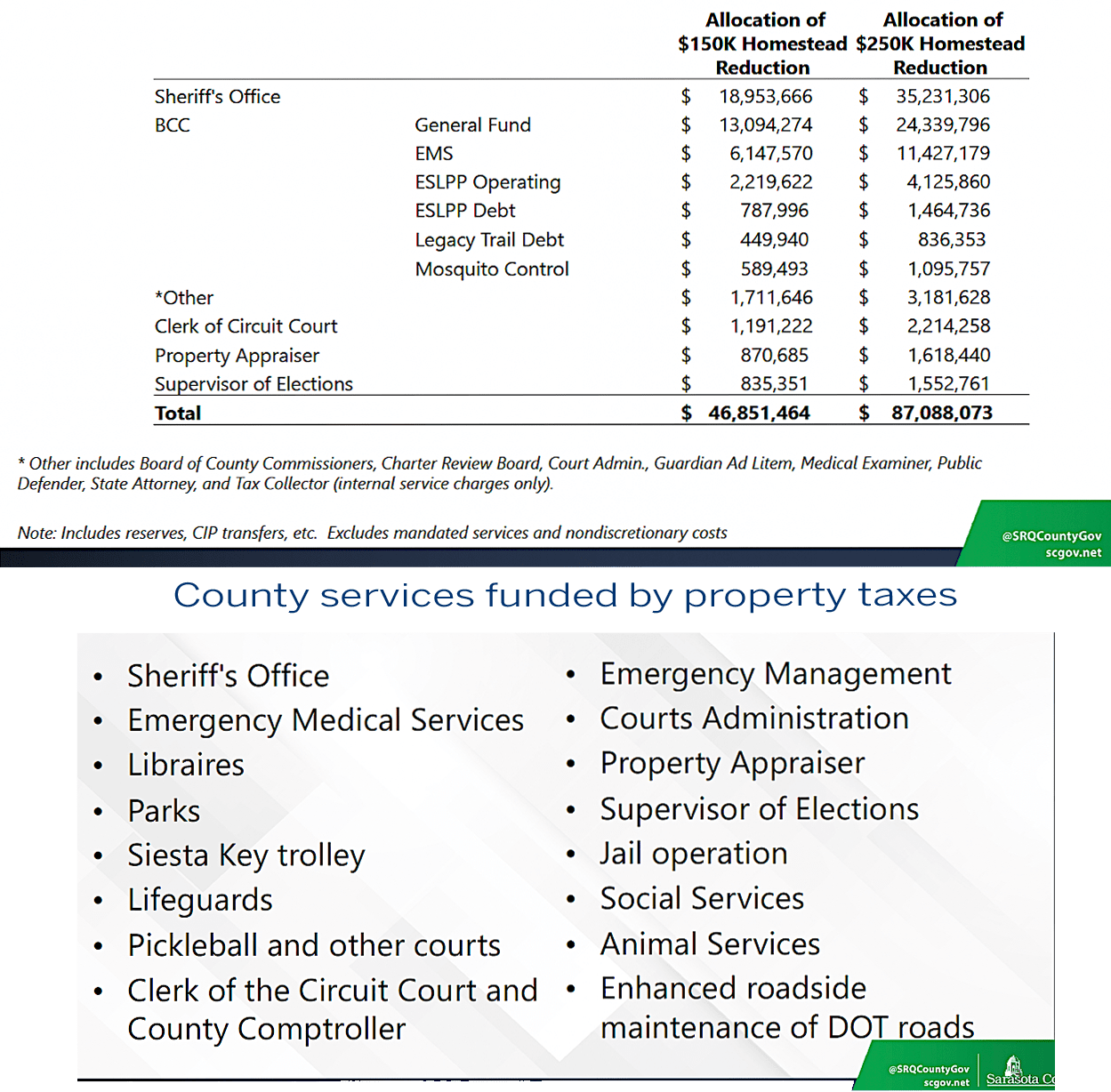
Impact to County services
Amendment supported by
Florida Legislature (75-27 House, with 16 not voting); 30-8 Senate, with 2 not voting), Florida Realtors.
Amendment opposed by
Florida Tax Watch, Florida Policy Institute, Florida for All, Florida PTA,Florida State Director of MomsRising/MamásConPoder, Southern Poverty Law Center, Florida League of Cities, Florida Association of Counties, Florida Rising, Florida Education Association, Pastors for Florida’s Children, SEIU Florida State Council/SEIU 1991, The Tax Foundation, Florida Student Power, Editorial Boards of the Wall Street Journal, Washington Post, Miami Herald, Orlando Sentinel, Palm Beach Post and Sun-Sentinel, Vote No On 3, 3º Degrees Florida, Floridians for Shared Prosperity, Florida Professional Firefighters, Florida Fraternal Order of Police, Florida Fire Chiefs Association, Florida Festivals and Events Association, Florida Sheriffs Association, EveryLibrary Institute, League of Women Voters of Florida, Florida Engineering Society, Florida Recreation & Park Association, Florida Rural Economic Development Association, 1000 Friends of Florida.
Sources used in CCNA calculations
- Sales tax calculation
- Special assessment calculation = $5,500,00 ÷ 27,104 taxable properties within the city.
- Homestead impact table